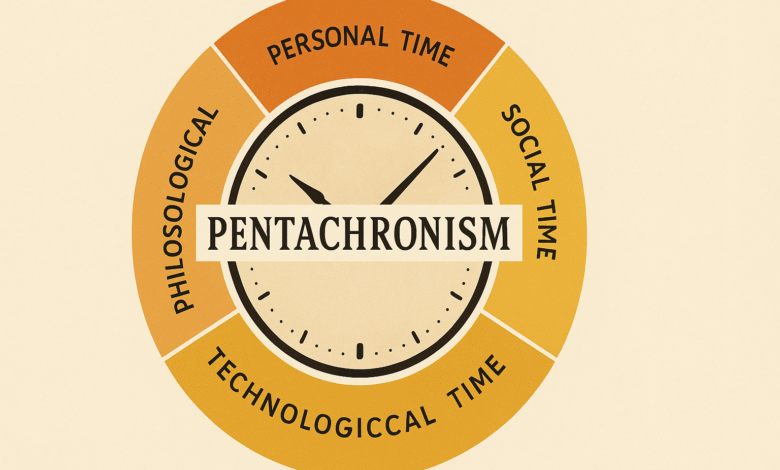
Pentachronism is a compelling concept formed from the roots “penta,” meaning five, and “chronos,” meaning time. Together, they frame an idea that time can be viewed, interpreted, and experienced through five unique dimensions. Pentachronism is not a scientific law but a philosophical and conceptual framework that encourages a deeper understanding of how humans relate to time. Instead of perceiving time as a simple line from past to future, Pentachronism expands the timeline into a richer, multi-layered experience that shapes our memories, choices, systems, and beliefs.
This five-dimensional outlook gives us the opportunity to pause and reflect. Time moves continuously, but how we understand it can shape our lives in significant ways. Pentachronism offers a fresh interpretation of the human experience, blending psychology, culture, philosophy, and technology into a united perspective of time.
The First Dimension: Personal Time
Personal time is at the core of Pentachronism. It represents the deeply individual ways we experience time. While clocks measure minutes with mathematical precision, humans experience time emotionally, mentally, and biologically. A joyful hour may feel like a passing second, while a moment of fear may stretch into what feels like eternity.
Personal time shapes how we understand our own lives. It influences how we set goals, how we heal from the past, and how we imagine our futures. It shifts depending on our mood, experiences, and environment. For example, the time spent waiting for an important message feels different than the time spent doing something enjoyable.
Pentachronism uses this dimension to encourage self-awareness. When we understand the rhythm of our inner world, we become more capable of managing stress, planning efficiently, and building healthier routines. Personal time reminds us that even though we share a world with billions of people, our internal experience of time is uniquely our own.
The Second Dimension: Social Time
Social time is the collective way groups, cultures, and societies organize and understand time. It includes holidays, work schedules, educational systems, traditions, and social expectations. While personal time is subjective and emotional, social time is structured and external.
In Pentachronism, social time explains how time becomes a tool of organization. Societies rely on time to coordinate everything from transportation to celebrations. Even our daily habits—such as eating meals at certain hours or waking up for school—are shaped by social time.
Social time also evolves. Some cultures use social time to emphasize community rituals, while others prioritize productivity and efficiency. Modern technology has further reshaped social time, speeding up communication and shrinking the distance between people around the world.
Understanding social time is essential because it reveals how we fit into the broader patterns of society. It helps us see how cultural expectations influence our sense of past, present, and future.
The Third Dimension: Historical Time
Historical time looks beyond individuals and societies to understand the movement of eras, civilizations, and global transformations. In Pentachronism, historical time allows us to recognize long-term patterns in humanity’s story—revolutions, cultural renaissances, discoveries, and conflicts.
Historical time shows us that we are part of a much larger timeline that existed long before us and will continue long after we are gone. It helps us learn from past mistakes, respect ancient wisdom, and understand how current events are influenced by roots stretching back centuries.
This dimension of Pentachronism encourages a long-term perspective. Rather than focusing only on the immediate moment, it helps us see how trends evolve across generations. Economic shifts, cultural movements, and technological changes are all part of historical time’s slow but persistent rhythm.
The Fourth Dimension: Technological Time
Technological time represents the rapid pace at which innovation transforms the world. Unlike historical time, which moves gradually, technological time accelerates quickly and unpredictably. New ideas can reshape entire industries, communication methods, and lifestyles almost overnight.
Pentachronism uses technological time to explore how humans adapt to constant change. Each new invention—from electricity to smartphones—reshapes how we live, work, and think. Technology influences personal time by changing how we manage our schedules. It impacts social time by altering work culture and communication habits. It even shapes historical time by speeding up global progress.
Today’s world is dominated by technological time. Automation, artificial intelligence, digital networks, and scientific breakthroughs are all evolving rapidly. Understanding this dimension helps us remain flexible, adaptive, and informed in a constantly shifting environment.
The Fifth Dimension: Philosophical Time
The final dimension of Pentachronism is philosophical time. This dimension explores the most profound questions about time’s nature, purpose, and meaning. It moves beyond measurable minutes or historical eras and instead touches the realm of metaphysics.
Philosophical time encourages reflection on questions such as:
- What is the true nature of time?
- Is time linear or cyclical?
- Does time exist independently of human consciousness?
- What does it mean to exist within time yet still imagine concepts beyond it?
This dimension deepens Pentachronism by reminding us that time is not just a physical phenomenon but a concept that shapes human identity and purpose. Philosophical time connects science, spirituality, and logic, offering a broader view of existence.
Why Pentachronism Matters in the Modern Age
Pentachronism offers clarity in a world where everything seems to move faster and become more complicated. By dividing time into five dimensions, it helps us balance personal needs, social expectations, historical awareness, technological changes, and philosophical reflection.
This framework is especially valuable today as our experiences of time become increasingly fragmented. Many people struggle with time management or feel overwhelmed by constant digital stimulation. Pentachronism gives us a grounded method for thinking about time more intentionally.
Understanding Pentachronism can lead to:
- Stronger self-awareness
- Better life planning
- Healthier relationships
- Clearer understanding of cultural change
- Improved ability to adapt to innovation
- Deeper philosophical insight
Through these benefits, Pentachronism becomes more than a concept—it becomes a guiding mindset for living a balanced and thoughtful life.
Practical Uses of Pentachronism
Pentachronism can be applied in many real-world contexts:
In education
Teachers can help students understand their personal learning pace, how historical events connect, and how technology shapes modern study habits.
In business
Leaders can plan with long-term vision, adapt to rapid technological change, and manage teams with respect for social time.
In personal development
Individuals can use Pentachronism to reflect on past experiences, stay mindful in the present, and set meaningful goals for the future.
In creativity
Writers, filmmakers, and artists can draw inspiration from the five layers of time to develop rich and multidimensional stories.
Conclusion
Pentachronism presents a powerful and imaginative way to understand time through five distinct yet interconnected dimensions. By exploring personal, social, historical, technological, and philosophical time, we gain a clearer and more meaningful understanding of our lives. This five-fold framework encourages balance, growth, awareness, and deeper thought in an increasingly fast-paced world.